Category Archives: Air quality monitoring

Another fracking LTE appears in….Greeley?

I was surprised to see a byline “Fracking fight” in the Greeley Tribune Letters To the Editor section recently (March 21, 2026), but there it was:

Work to monitor fossil fuel sites slow, but hopeful


After blinking my eyes in disbelief, I was pleased to see that the author was our friend in Ault, Carol Hawkins. She also pointed out how much work that Andrew Klooster with Earthworks has done over the years. She has worked closely with him to document many emissions violations in Weld County; and notes that the response rate of the ECMC to such complaints has increased from about one third to fifty percent in 2025.

Small steps towards progress; but, yes, it is indeed hopeful, and I hope it continues.

And now, an update from our favorite adversary…

See the link to the article below

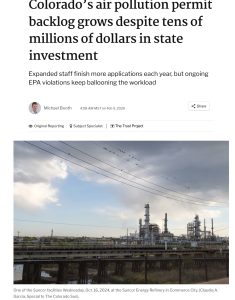
Earlier this week, the Colorado Sun provided a valuable public service by keeping us updated on what’s going on at our favorite state regulator, the CDPHE, otherwise known as the Colorado Department of Public Health and the Environment, and our other favorite bête noire housed within it, the APCD, or the Air Pollution Control Division:

 Colorado’s air pollution permit backlog grows despite tens of millions of dollars in state

I sent a letter to Mr Booth about this (reproduced in full below), in which I thanked him for the fine article, but at the same time expressed my dissatisfaction with what was missing from his report…which we at the Larimer Alliance have been repeating since oh, at least, 2020.

Plus ça change, plus c’est la même chose…🙄

The newsworthy bit was the backlog for air emissions permit applications has grown, which happened because of the EPA downgrading of our air quality in  2022 from “serious” to “severe”. This downgrading of the air quality triggered a section of the regulations that states that more, and smaller scale, point sources of air pollution would need to file for emissions permits, and start reporting them.

Which raises the interesting question: does reporting the amount of emissions means that the pollution gets reduced? I have long wondered about this question; but never got around to actually asking it of the CDPHE/APCD…until now. If I get a reply from them, I will be sure to share the results here.

However, I’m not holding my breath, as I have lived with the equivocating language coming out of these agencies — in which they will avoid, evade and obfuscate the question beyond recognition in order to avoid their civic duty to actually protect the environment — that I do not expect any change in their behavior until there is a drastic change in the politics behind it…which is why this activism continues.

Rather than reporting the facts and figures of the article, which you do for yourself, I will point out that the $20 million additional state funds that the Polis administration extended to these agencies in 2022, in order to allow them to deal with the increase in pollution permits, is probably not going to help matters. These agencies are not likely to change their spots anytime until forced to do so by political change. They will continue to avoid, evade and obfuscate ad nauseum.

What they could have done to really start to reduce our air pollution is actually start measuring it. In order to do that, they need to actually build the air quality monitoring equipment that can do this. The existing monitoring stations are not anywhere near capable of doing this. The existing monitoring stations mostly exist to allow the state to say they are measuring ozone; they do not exist to measure the ozone precursors, which come from two primary sources: 1) oil and gas operations, and 2)  vehicular traffic.  A tiny fraction of the state monitors can detect some of these ozone precursors; but these have been installed only recently, it would seem, as an afterthought, and are certainly not the purpose for which the overall system was designed.

In my humble opinion, just part of that $20 million would have been much better spent by standing up three or four Bouder AIR monitoring stations (see bouldair.com)  and if and only if something would actually be done with the data — such as identifying where the precursors are coming from, identifying those point sources by combining regional monitoring with better on-site monitoring. Neither alone is sufficient for meaning pollution reduction. And none of this has any meaning or purpose unless the spirit of the law is enforced: by actually reducing our air pollution.

Even better would be to measure and transparently report how our environmental quality and health are improving — which is the real point of reducing our pollution, right?

In a word, simply informing the public how much we are getting polluted — and telling us to stay inside on bad pollution days — is not enough. We need hard data — quantitative and publicly transparent data — in order to believe our state agencies are actually helping to protect the environment and human health. Words are not enough.


[My letter to Michael Booth, reporter at the Colorado Sun, Feb 5, 2026 ]

Greetings Mr Booth, 
Many thanks for the fine article in today’s Sun, Colorado’s air pollution permit backlog grows despite tens of millions of dollars in state investment. The shortcomings of the CDPHE in addressing our poor air quality are too little known to the general public.
I appreciated as well the excellent coverage of attorney Jeremy Nichols’s valid criticisms of the lack of action by the CDPHE when issuing their emission permits; they could be doing so much more than they are. 
Speaking from years of observing this issue, I would like to point out a critical missing piece of the puzzle from this critique of the CDPHE and how it is addressing our air quality; namely, the measuring of it.  
All of the figures mentioned (such as “…the amount of released nitrogen oxides, a key precursor to dangerous ozone, to 156 tons in 2023 from 276 tons in 2011…”) are based on models, not actual measurements. Those models are based on data. Those data are provided by the O&G industry. We are suspicious of those data, their models, and just about everything else the CDPHE does, who seem totally captured by the O&G industry they are ostensibly regulating. 
At the Larimer Alliance, we have been advocating for years that the CDPHE needs to measuring our air quality through direct air sampling, and publishing those results in a prompt and transparent manner — which has been technically possible for years. But they have stonewalled us and other environmental advocates, safely hiding behind their bureaucratic walls. 
I intend to post to our blog soon on this article, and will let you know when it is published. 
Again, thanks for your fine article. 
Best, 
–Rick
——————————–

Rick Casey 

“The need to transition off fossil fuels”…a LTE hits a home run!

In case you missed it, there was an impressive event that happened recently with regard to environmental activism: a Letter To the Editor (LTE) about the danger of fossil fuels was published in three local papers  — Greeley Tribune; Loveland Reporter Herald, and Longmont Call Times — simultaneously! This is an unprecedented accomplishment, which deserves some recognition.

The author, Carol Hawkins, has been part of the Larimer Alliance for some time; and during that time, has sought a resolution to her situation, but has come round to the same grim realization of others in the community: until the state regulators of O&G see the light, and begin to limit the issuing of new drilling permits, local residents are almost powerless to stop them. All that SB-181 accomplished, it would seem, it to guarantee at least as 2,000 foot setback from any new well.

Below is Dr. Hawkins’ LTE, taken from the Greeley Tribune, 11/19/25:

Colorado faces a difficult choice, transition off fossil fuels to renewable sources of energy or continue to jeopardize our environment and health. Transition will cause economic and social disruption for workers and communities.  Any “just transition” requires solutions that mitigate the negative consequences while simultaneously eliminating the deadly pollution caused by burning fossil fuels.

I have lived in Weld County since purchasing my house in 2017. I lived in Maine at the time, near the end of an ”unexpected journey” watching my partner die from Alzheimer’s. I decided to move back to Colorado where I had family and a history of living in the state since the early 1970s. I wanted familiar surroundings. I searched online and found the perfect bungalow, my retirement home, in Ault, a rural town in a good location between Greeley and Fort Collins. I had no idea of the influx of fracking about to come. Shortly after moving, I received a forced pooling notice. I went from grief and PTSD to a sense of doom. Fracking! What did this mean for my quiet life and my health?

The facts about fracking and the impacts were easy to find, but fighting the frack hasn’t been easy. Weld County, otherwise known as “Welled” County, remains the most polluted and fracked in the state. My neighbors, many who work in oil and gas, are mostly working class, and others are first-time home owners looking for affordable housing or long-time residents. Local government is staffed by those who appear unaffected by fracking. When wells were drilled next to the Highland School campus, located in the middle of town, I called the Ault Town Office and Weld County Oil and Gas to question why the drilling was so close to the school when SB 181 called for 2,000-foot setbacks. The Ault Town Office said that they had no knowledge of drilling near the school, although it was happening just down the street, and the Weld County Oil and Gas Office laughed off my reference to SB 181 with the comment “those rules are easy to get around.” And I’ve come to learn that he is right. All you have to do is look at the loopholes. One is home rule, the other is reverse setbacks.

I then turned to the state and began to protest permits, but soon learned that state regulators and the governor support the fossil fuel industry. However, outside of Colorado, a global consensus calls for a “just transition” away from fossil fuels. The planet is heating, driven by greenhouse gases from extracting and burning fossil fuels like oil and fracked gas. Agreements from COP28 called for net-zero emissions by 2050.

Current research, developed by analyzing efforts toward a “just transition” around the world, provides principles that guide policy development: governmental support, dedicated funding streams, strong and diverse coalitions, and economic diversification to address the short-term impacts and long-term needs of workers and communities.

Colorado must come together around this framework of principles for a “just transition,” but the transition from fossil fuels to renewables will still disrupt existing economies, and some communities may face economic hardship due to the loss of jobs and tax revenue from the fossil fuel industry. However, we must make the hard choice to experience the gains from a clean energy economy and healthy environment.

Colorado’s current environmental damage and health impacts are not sustainable and challenge communities reliant on oil and gas to make the hard choice — we need a “just transition” off of fossil fuels. Stop the permits and clean up the mess while supporting displaced workers and disproportionately impacted communities, like Ault.

[Carol Hawkins is a retired English professor who moved back to Colorado from Maine in 2017. She was served a forced pooling notice in 2018 and has been part of the resistance to fracking ever since. Her focus centers on health impacts and damage to our environment, with a particular interest in health care and job training for displaced oil and gas workers, along with support for disproportionately impacted communities like hers in Ault. Dr Hawkins noted that all three papers are owned by a single company, which could be a factor in her LTE appearing in all three simultaneously.]

Is coal really dead? Or have pigs learned to fly?

This blog post was motivated by this recent op-ed in the Denver Post by the esteemed Jonathan Thompson (whose articles I’ve read for years in High Country News), “Trump gives coal a boost, guts renewables and will return haze to the Four Corners” My apologies if you hit a paywall with that link — but I’ll give you the gist here.

Also I’ll get to flying pigs by the end of this…and, yes, that does have something to do with the Trump administration.

What Thompson describes in his piece is how achingly clear the air used to be in the southwest — so clear that back in the 1950’s, if you were in the La Plata mountains in southwest Colorado, which are north of Durango, you could see the Sandia Mountains outside of Albuquerque, New Mexico — about 200 miles away.

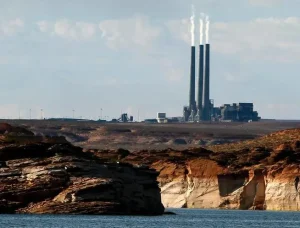
No longer: due to the construction of a “fleet” (a dozen?) of massive coal burning plants throughout the Southwest in the 1950s and 60s, that clarity  blurred to limiting such vistas to just 50 or 60 miles; and haze was the least of the environmental harm, which included increased respiratory disease, cancer and shortened lifespans. The size of these plants was massive, since they were located far from urban areas, such as this shot of the Navajo Station above Lake Powell (those smokestacks are over 700 feet tall):

Navaho Generating Station from Lake Powell, 9/4/2011

After they were constructed, there was growing awareness, and protest, against the increasing haze and air pollution that the plants caused over the following years. Though it took decades for the evidence to accumulate, be gathered, filed in legal cases, and work through the courts, a settlement was finally reached in 2015, in one of the largest settlements against coal plants in history, the Four Corners Power Plant Clean Air Act Settlement. In all, six of these highly polluting, smoke belching behemoths of power plants have been closed since that time. And the air quality has improved significantly as a result.

I was able to find this dramatic video footage of the Navajo station coming down, which was quite iconic: Drone video captures the demolition of the smokestacks at the Navajo Generating Station. This was likely something many of local Navajo residents, on whose land it was built, never thought they’d see in their lifetime.

This video is more likely what you would have seen had you been there in person: Massive coal stacks demolished that long towered over Lake Powell In this video, there are Navajo interviewed who worked in the coal mines or at the power plant most of their lives; but they acknowledge the need to move on, that renewable energy is the future.

Not so with this Trump administration; it is seeking to promote the obsolete coal industry to continue to generate electricity. Even though all the major power utilities in the country are uniformly moving away from coal, this administration thinks it can stop such market forces with a presidential order — as if markets ever obeyed presidents. Nonetheless, the administration is using this as an excuse to release the electric power companies that still have coal plants from environmental regulations meant to improve our environmental quality; and so a handful of coal-burning power plants are going to be allowed to increase the polluting of their surrounding environment — as if that is really going to amount to a hill of beans in the overall scheme of things. Trump’s administrators making these decisions will go down in history as badly misguided, utterly uniformed sycophants who are only making climate change worse, forcing bad investments on industry, and lengthening the time it is going to take to stabilize the global climate.

I think we are going to see pigs starting to sprout wings and fly before we see the coal industry taking off again. But will the emperor see that he has no clothes and change his mind? I doubt it.