This update from the Larimer Alliance comes to you after somewhat of a hiatus, as we developed a new strategy to deal with our on-going air pollution problem; apologies for the long silence since January. I hope this post will convince you that the mission of the Larimer Alliance is still worthwhile, and worthy of your support. This post describes our current strategy; it is followed by an appeal for your financial support and an invitation to volunteer to help with our steering committee.
Here is an overview of our activities in 2025:
- January 2025, the Larimer Alliance presented a plan to the County Commissioners of how to provide a continuous air monitoring station at no cost to the county through a state grant; the commissioners rejected our proposal; see this blog post about that.
- February 2025: the Larimer Alliance met in a zoom call with KC Becker to discuss our strategy for improving state regulations regarding our ozone air pollution; see details below.
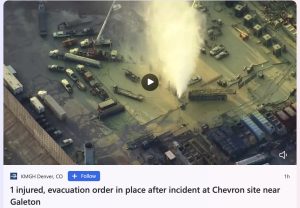
- April 2025: the Galeton well blowout occurred, and we published this blog post on it. This issue is not over, and we will continue to cover it. In fact, Earthworks released a video just today about this, which we sent out earlier today.
- May 2025: the Larimer Alliance met in person with county commissioner Kristin Stephens to discuss our future strategy about improving our air quality; see details below.
- June 9, 2025: sent out a message about Earthwork’s short video upate about the Galeton blowout.
The Need Has Not Gone Away
As the recent article by Phil Doe pointed out (“Sun should set on Suncor”, Boulder Weekly, May 26, 2025), our air quality is still a problem in the Front Range. It is particularly bad for the Cultivando community that lives in the shadow of Suncor in Commerce City; hence Mr Doe’s strong suggestion that the Suncor refinery needs to be closed, a recommendation with which the Larimer Alliance would heartily agree. The Air Pollution Control Division (APCD) is the agency that issues companies their permits to emit; and it is also the agency that issues fines against companies that violate their permit.
Though Larimer County’s story is different than Cultivando’s, we share some things in common; namely, a governor that continues to favor the O&G industry over public health; and a regulatory regime under his influence that allows the O&G industry to continue to pollute us with impunity.
It serves as a reminder that we need to continue our efforts to raise awareness about the causes of our poor air quality, and persevere in our efforts to correct it. In these dark political times we need to invest in and continue to build real community, to help each other face our common reality, and work together to lay the foundations to build towards a better future.
The Need Has Actually Increased
In support of our claim about the lax attitude of our regulatory agencies, there is strong evidence from the non-profit EarthWorks (see earthworks.org). See this comprehensive report, “Earthworks Field Survey 2024 Report for Colorado“, March 14, 2025. Due to Earthworks hard field work, some improvements have been made with some individual operators making corrections to their equipment.
However, the APCD’s rules allow for considerable latitude by operators with regards to their emissions. A major one is that when performing “maintenance procedures”, when they are allowed to release essentially unlimited pollutants until the procedure is done. This was recently documented in this video of a gas plant outside Frederick, filmed on May 3, 2025. In the words of the videographer, Andrew Klooster, it was “…one of the worst emissions events I have ever filmed.” Even though Klooster filed a complaint with the APCD, such massive emissions are totally legal because the operator is allowed to do so. One wonders if such voluminous venting is really necessary; or was it more of a public taunt by the operator, showing he could do as they pleases, as long as they are doing “maintenance”?
Our Strategy Is Based On Guidance From Trusted Sources
This February, Ed Behan and I met via zoom with KC Becker for about an hour of discussing what our strategy should be going forward to get better air quality enforcement actions. For those who are unfamiliar, Ms Becker had a distinguished career in the state legislature from 2013 to 2021, followed by serving as our regional administrator of EPA Region 8 during the Biden administration. She is currently the director of The Colorado Solar and Storage Association.
We were very lucky to get to spend some time with her, and we are taking her suggestions to heart. When we expressed to her our frustrations with the state regulatory agencies in charge of improving our air quality (primarily the APCD within the CDPHE, though the ECMC is also involved), and overseeing the oil and gas (O&G) industry, we thought the remedy would be to develop new legislation, which would force these agencies to enforce tighter environmental standards. Such standards simply must have the goal of reducing overall emissions, as this is the only solution to reducing our dangerous ozone levels, as well as making progress on dealing with climate change. However, KC suggested a different tack, and instead focus on targeted legislators to form a caucus around the issue. They would have the power to call in the relevant regulatory staff, and ask them to review what needs to be done. We were grateful for this suggestion, and plan on adopting this into our strategy.
Our next source of guidance came from Kristin Stephens, who is term limited in her current role as a Larimer County Commissioner. She had been receptive to our platform for improved environmental quality, even though the three commissioners did not vote for acquiring a Boulder AIR monitoring station back in January as we had hoped. She agreed with the strategy suggested by KC, and as well encouraged us to begin attending meetings of the Regional Air Quality Council (or RAQC, see raqc.org), of which she had been the liaison member from Larimer County until recently.
This somewhat cumbersome and vague title is actually rather apt to this somewhat cumbersome and vague organization. Composed of no less than thirty-six board members, they run the gamut of representatives from public and private organizations and individuals. They are all appointed by the governor. Their mission statement is:
We collaborate to improve air quality and protect Colorado’s health, environment, and economy through planning, policy development and program implementation.
If you have been involved in activism as long as I have, you might view such a large group, who have banded together under such a vague commitment, which has no legally binding force behind it, who are all politically appointed by the governor, with a certain degree of scepticism. Given that the Front Range’s air has been out of EPA compliance with ozone levels since 2004, and the RAQC has been around since 1989, we can conclude that the RAQC has not been very effective at keeping our air clean.
Still, one has to start somewhere; and at the close of our meeting with Kristin I made a point of asking her: is the public allowed to comment at these RAQC meetings? “Yes, you certainly can..and you should.” was her reply. The Larimer Alliance intends to get started in developing a communication channel with them, which is apparently the appropriate place for local citizens to make themselves heard about air quality.
Our Current Strategy
We intend to form a caucus with selected legislators and other interested parties around the issue of our poor air quality. We need better air quality monitoring, with the goal of reducing overall emissions. Since ozone precursors come from both vehicles and O&G operations, we need a monitoring system capable of measuring the relative contribution of each source, continuously and in real time. No existing monitors are capable of doing this, which is why we continue to push for the acquisition of a Boulder AIR station, along with a plan by the state for how to use the data. The CDPHE needs to explain to the public why they continue to refuse to accept Boulder AIR data as valid — even when this data has been validated by the EPA and is more precise than any sensors currently maintained by the state.
The Need for Community in Dark Times
I truly believe in the work of the Larimer Alliance, and in our struggles to protect the health and safety of our environment from the pollution caused by the oil and gas industry.
To do that, we need the support of the community; and you can help in these two ways: we will need additional funding to make it through this year to cover our minimal expenses; and we could use some additional volunteers on our steering committee to help share the work involved. We will be sending out a fundraising email soon, and I hope you will consider a donation. Our donation page is found on our website’s Donate page, and our volunteer page is found here.
Building community is also helped by holding events where people can see each other, and get to know one another. We would like to hold some events during the summer months, and will send out notices about them. If you have any suggestions for such events, please let us know! You can make suggestions by commenting on this post.