Category Archives: Local government (city & county)

Senator Pelton hears from a constituent

We received the following comment from a subscriber who had an exchange with their state senator, Senator Byron Pelton, by calling his office in regards to the Galeton blowout. He returned her call with additional comments; we have chosen to publish this exchange in the larger interests of informing the community. (You can check out Senator Pelton’s wikipedia bio here.)


Senator Pelton,


Your comment that our air pollution comes from China is false. If you’re going to represent communities under ozone alerts and declared by the EPA as a “non attainment zone” for air quality, I suggest you educate yourself. While you admit your bias, that you were able to acquire large sections of land because you leased your back yard to oil and gas development, you don’t have the right to pollute the larger community. Those oil and gas wells are a major polluter to our environment, particularly in “Welled” County.


AI Overview:

Yes, air pollution from Beijing can reach Colorado, but it’s not a significant factor in Colorado’s air quality compared to local and regional sources. While Chinese pollution is transported across the Pacific Ocean and impacts the United States, including the West Coast, the primary contributors to air pollution in Colorado are local emissions from vehicles, industrial activities, oil and gas production, and weather patterns like inversions.
1)  Beijing’s pollution and its impact:

China is a major emitter of air pollutants, and some of these pollutants are transported across the Pacific Ocean, affecting air quality in the United States, including the West Coast.

2)  Major sources of pollution in Colorado:
In Colorado, the main contributors to air pollution are local sources like vehicle emissions, industrial activities (including oil and gas production), and the impact of weather patterns like inversions, which trap pollutants near the ground.
3)  Impact of Beijing’s pollution on Colorado:
While Beijing’s pollution can be a factor in the overall air quality in the United States, it is not the primary driver of poor air quality in Colorado.
4)  Comparison of air quality:
Denver’s air quality can be worse than Beijing’s on specific days, especially during rush hour or due to local inversions, but on average, Beijing has a higher number of days with poor air quality, according to a 9News article.


Please educate yourself on air quality issues in our district. Bias has no place in our politics and your bias in favor of oil and gas is clouding your thinking and misinforming the public, which I will call out every chance I get.

An Aware Constituent,

Carol Hawkins
Ault, Colorado

The Commissioners reject a Boulder AIR station for now…so what’s next?

The Larimer Alliance has been a bit busy and preoccupied ever since  the Trump administration started its destructive campaign of slashing and burning vast swaths of the federal government, so please forgive the lack of communication; but we are now back, and want to keep the community informed we have been up to.

There have been some definite developments which we would like to relate.

Our hopes for the AQE solution

The Larimer Alliance had led a sustained effort since fall 2024 targeted at the Larimer County Board of County Commissioners to see if we could get their support for supporting a Boulder AIR station here.  To that end, we attempted to get the CEO of Boulder Air (BA), Dr Detlev Helmig, to give a special presentation to the three county commissioners. We wanted to make sure the commissioners had the best information possible, and clearly understand what BA stations can do, and why they are the best technology possible for a regional approach to air quality monitoring. Our hope was to get Dr. Helmig before the commissioners by January 2025, and shortly thereafter ask the county to apply for a grant from a state agency that was created in 2020 for this purpose, the Air Quality Enterprise. (AQE)

We had good reason to think that Larimer County would have had an excellent chance at receiving such a grant.  The grant would have  paid for a BA station for at least one year, and possibly longer.  Our hopes were based on very tangible evidence: direct contact with the funding source itself.

Ed Behan and I had a Zoom meeting with the executive director of the AQE, Jeremy Neustifter, on November 18, 2024. We explained to Jeremy our simple goal: to get a Boulder AIR monitoring station so that we can measure our air pollution; specifically, the ozone precursors…more specifically, the ozone precursors coming from the two primary sources: vehicles versus O&G activity. And, more specifically yet, the amount of ozone precursors coming from O&G activity in Weld County. We happen to think that would be a pretty useful number to know; it seemed like a perfectly reasonable object of air quality research.

Mr Neustifter was very understanding of our concerns. He was quite open about the mission of the entity, which is to encourage research into such questions. So, he encouraged us to ask Larimer County to apply for a grant. Ed and I were uplifted by this development, and set to work contacting our county commissioners with this news.

The BOCC Rejects Air Quality Monitoring…for now

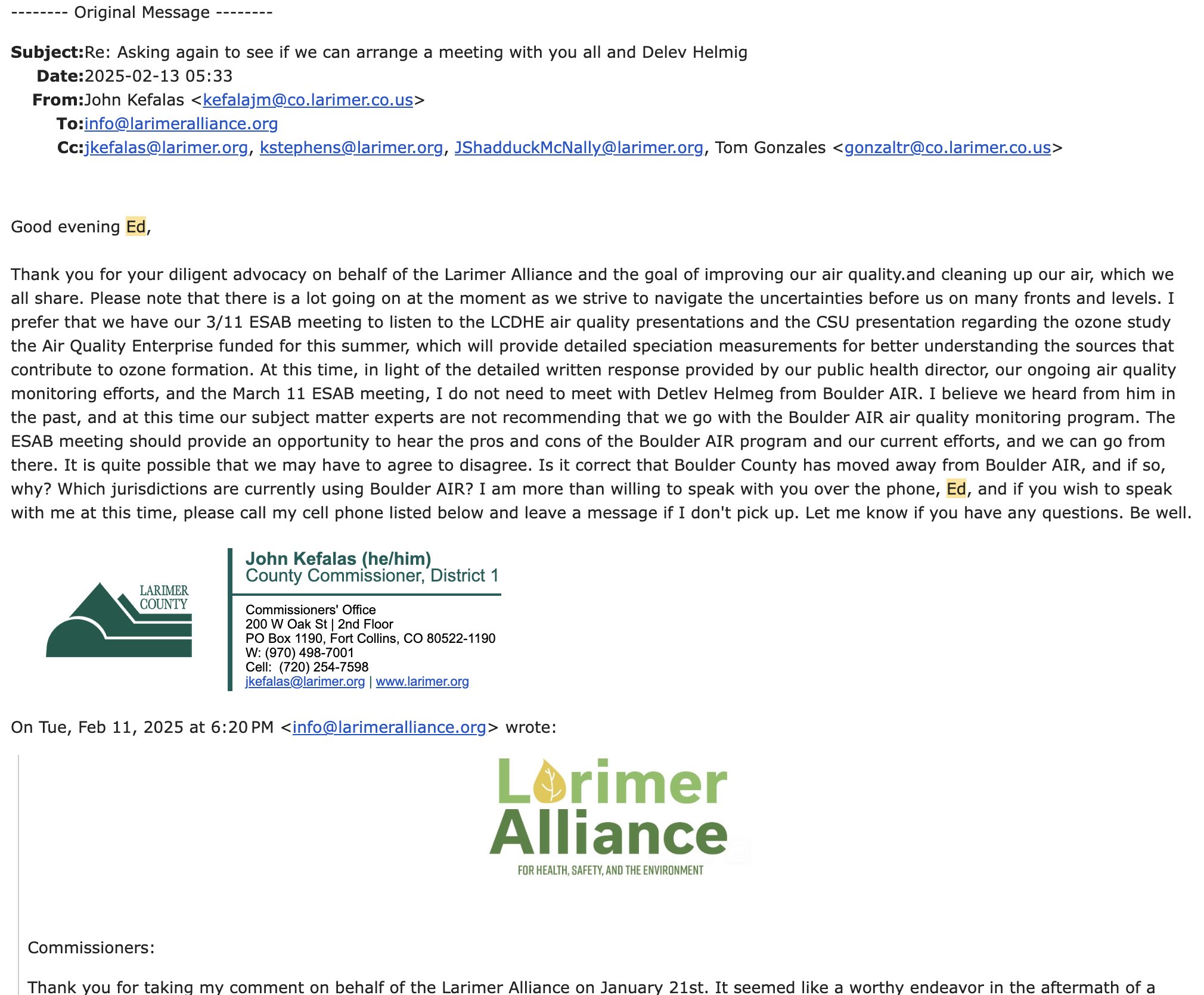
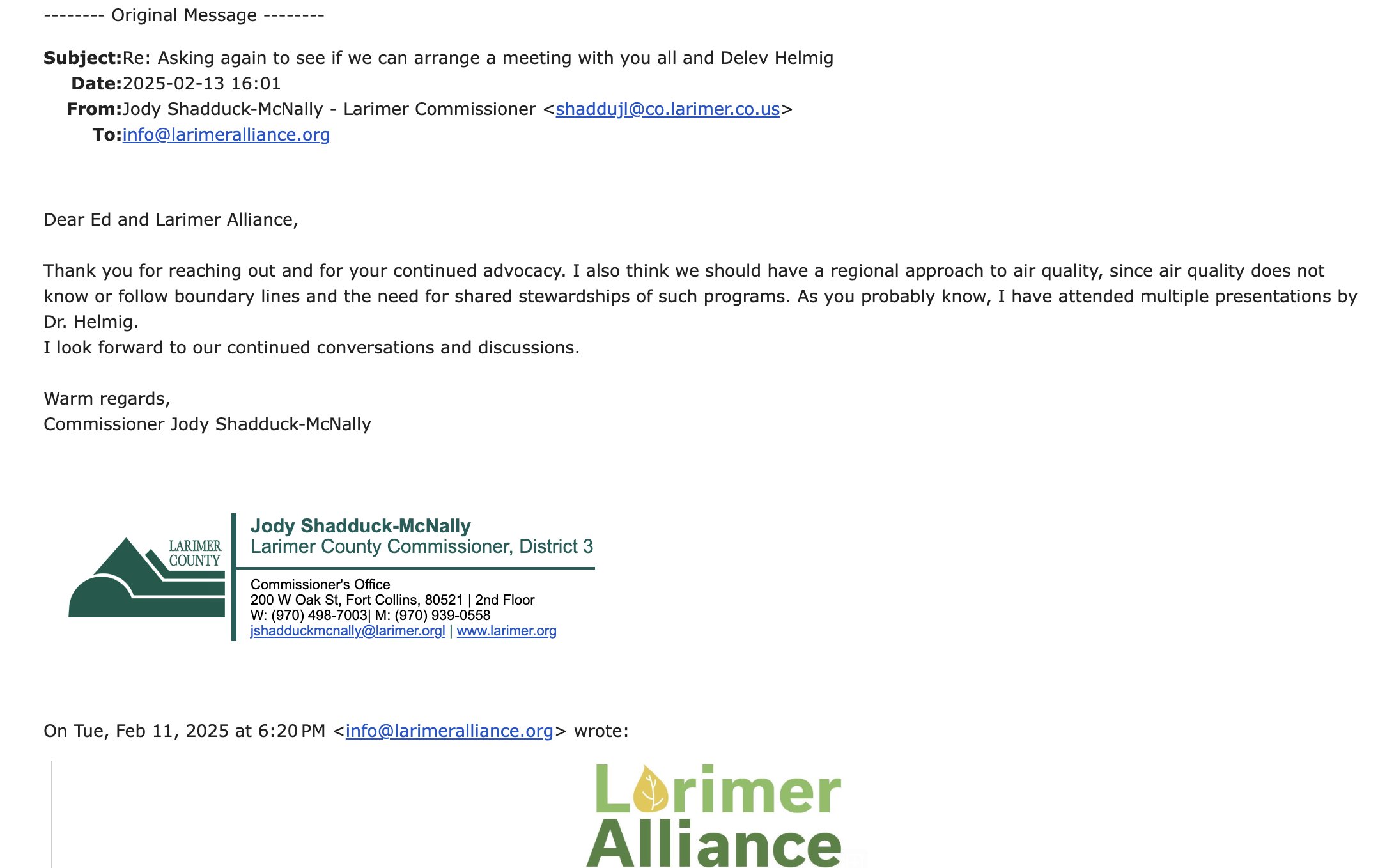
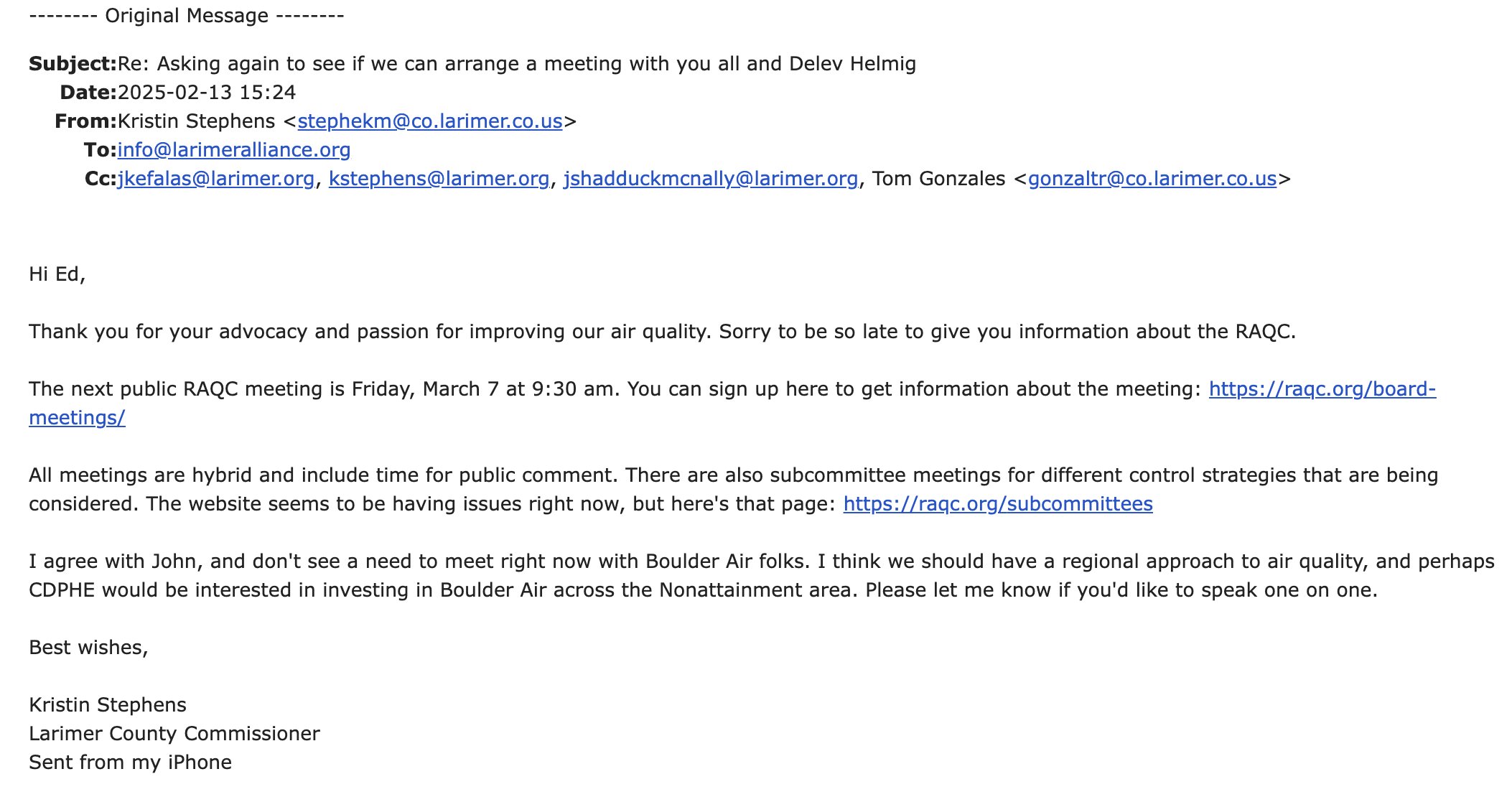
With our best efforts of dangling the bait before the BOCC which we thought would be a slam dunk — who wouldn’t want better air quality monitoring paid for with a free grant? — the commissioners did not bite. Here is what they said: (click on the image to see a larger version)

As you can see, we got turned down cold; none of the commissioners expressed interest in pursuing a BA station at this time.

Still, the response by Commissioner Stephens did leave a bit of an opening, inviting us to participate in the Regional Air Quality Commission meetings. We are aware of the RAQC, but had not focused on them as a suitable lever of action…until now. Since Larimer County views them as the appropriate arena in which to pursue a regional approach to our air quality issues, the Larimer Alliance will need to do so as well….

Stay tuned! More developments are sure to come.

Remarks to Boulder County Commissioners, December 19, 2024

Screenshot

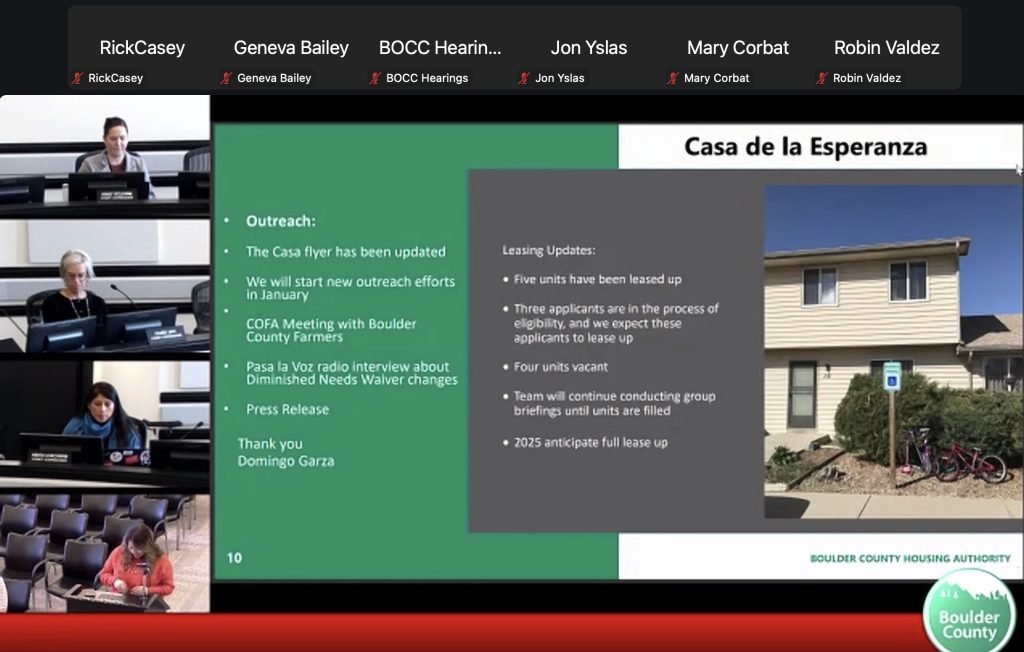
The words below are, more or less, what I said to the Boulder County Commissioners when I participated via Zoom at their meeting. I was the only person who spoke during the public comment period. My participation was audio only. The main meeting topic was about their public housing, so I’m sure my comments must have caught them by surprise, and all three of them looked a bit miffed as I delivered my three minute tirade:

Good morning commissioners and staff: 

My name is Rick Casey, and I’m a resident of Fort Collins. However, I did live in Boulder County for several decades before I moved to Fort Collins in 2018. Since 2009, I have taught a class in environmental economics at Front Range, and have been involved in local environmental activism  since 2012. I support five websites related to those issues, through which I’ve gained some perspective on these complex problems. So I am speaking today on behalf of the Larimer Alliance, a non-profit dedicated to protecting the health and well being of Larimer County from the O&G industry. 

I wish to speak to you regarding your recent decision to stop funding the Boulder AIR monitoring program. I think this is quite a wrong decision, which has come as quite a shock to the environmental community in the area. 

This is not the time to stop monitoring our air quality. If anything, the need to do so will be increasing, not decreasing. The incoming Trump administration is poised to promote more drilling, weaken regulations on the industry, and, in general, increase the rate at which we are polluting the environment at a national level – and this is sure to have its effects on us at the local level. 

As a rather striking example of just how valuable this program is, it is my understanding that the methane data collected at the Boulder Reservoir station was instrumental in influencing the passage of new and stronger regulations in 2021 by the Air Qualty Control Commission that mandated improvements in O&G field operations. The new regulations mandated the use of pneumatic valves, which could reduce the amount of fugitive methane. This was a non-partican, multi-group effort that included both industry and environmental advocates. Since the implementation of these new valves, I have heard that – lo and behold! – the methane readings are indicating that the amounts of the fugitive gas have…indeed…decreased. 

Now this success story should not be cause for concluding that the need for monitoring is over. Until the amount of wells in Weld Country goes down dramatically, that need will never be over; and, if anything, this new administration worries me that the need will increase dramatically. 

Another reason I would be sad to see the Boulder station be retired is because I and my colleagues in the Larimer Alliance are trying to get our county commissioners to support getting a Boulder AIR station up here in Larimer County. We believe the other four Boulder AIR stations, if combined with a fifth station in Larimer County, would be highly effective in a detailed analysis of the sources of air pollution, and then be used to inform the best policies to address it. 

BECAUSE LIKE THE OLD ADDAGE SAYS: YOU CAN’T MANAGE WHAT YOU DON’T MEASURE!

So I hope you can understand why we feel the Boulder monitoring program is still needed. 

Thank you.

What will become of Boulder’s air quality program?

As you may have heard, the Boulder County Commissioners have decided to drop support for their air quality monitoring program in 2025. This is unfortunate, since this hardly seems appropriate. The air quality in the Front Range has been getting worse, not better, so removing this key data gathering point would weaken the ability of the Boulder community to argue for improving it. It could also weaken regional support from neighboring jurisdictions for their own programs — such as we want to get here in Larimer County.

The Boulder AIR monitoring at the Boulder Reservoir was the first such program to go into operation in September 2017. It did not have a specific mandate other than to notify the county Health Department if it spotted a specific threat to the environment.

One such threat is methane, or natural gas, a key GHG because it is more potent that carbon dioxide in causing global warming. By providing key data about methane emissions detected there from 2017 to 2019, this furnished the Colorado legislature with sufficient information to enact statewide rules in 2020 that mandated adoption of better control valves that let less methane escape during wellsite operations. (See ‘Colorado Passed the Nations First Regulations on Pneumatic Controllers‘, Colorado Local Science Network, March 2021). 

Dr Helmig, CEO of Boulder AIR, informed me of the findings from the air monitoring, which I would otherwise have been quite unaware. How the state legislature discovered that O&G operations could reduce their methane leaks by using better valves remains a mystery; but the point is that Boulder’s monitoring station provided the key information that was needed. It provided the impetus needed to focus on the specific pollution source; and, since then, has quantified how much that pollution source has been reduced.

None of this would be possible, of course, if such accurate, reliable and comprehensive (in terms of continuous time measurements) data were not available. If anything, Boulder County should be continuing its air quality program, and working with the other Boulder AIR monitoring stations to improve their identification of the specific sources of our air pollution.

The commissioners may say, no doubt, that they justify the elimination of the program based on its cost. (Such Boulder AIR stations cost about $250 thousand a year to operate.) While it is easy to identify the cost of this operation, it is more difficult to identify the benefits; but the benefits are there. In the previous article mentioned above, it estimated that such valves caused “29% of the oil industry air emissions nationally”; which, according to the EPA, “estimates that these devices emit nearly 2 million tons of methane a year into the air nationwide.” That sounds like sound benefits to me; but, of course, those are benefits the Boulder county commissioners seem to have a hard time seeing.

I would note that Broomfield dropped its support for their Boulder AIR station before too. In October 2023, a divided council narrowly voted to end that program, based on suggestions from its city manager, Jennifer Hoffman. But after much public outcry and testimony in the following months, the council reversed its decision, and the Boulder AIR stations (Soaring Eagle and North Pecos) were restored later in 2024.

The Boulder commissioners might want to examine what happened in Broomfield before making their decision. There is an undeniable need for such monitoring to protect our public health; what is in question is the political will of our local officials to supply it.